The Great Merging

0

[ad_1]

As the pandemic has merged all our boundaries of work and personal lives, in many cases permanently, and as technology and life conveniences recalibrate to address this lived reality of ours, the global travel industry is going through its own version of what we’re calling The Great Merging.

Lines have already blurred beyond recognition between our personal and professional lives over the last two-plus years and it is showing up in profound ways in the global industry at the center of selling this dream.

Nowhere is this more profound in the spring of 2022 than in the lodging sector – in fact we’ve created a whole conference just around this happening this week in New York City – between hotels and short-term rentals, offering a touchstone example for all of travel. But more on that later.

More broadly, how we live, work, socialize and travel have merged into each other as we come out of the pandemic. This has material implications for all parts of the travel ecosystem, from how it is researched, designed, marketed, sold, consumed and shared and how the industry is structured to cater to the world in which travelers are driving this merged future of travel.

This was awhile coming.

Ever since the start of Skift a decade ago, we have been covering the collapsing of industry silos, mostly because consumers have been in charge. One of my favorite early lines while pitching Skift to investors and indeed readers through our coverage was to break the silos in travel and focus on trendlines in travel, beyond the headlines. Here’s why, I wrote back then: “We are fanatically focused on the changing consumer behaviors across all sectors, not just travel — whether because of digital tools or globalization or other generational factors — rather than what silos are doing talking among themselves, and how that affects travel and its future.”

We were also covering the changed travel purchase cycle, a totem the travel industry had held on to for decades prior to the world becoming digital. We argued that through the phases of dreaming, planning, booking, destinations were all blurring into each other and consumers were jumping across all of these using all the digital tools at their disposal.

We were also early in picking up the trend of the rise of local in hospitality, the variety of ways that hotels — mostly boutiques — were trying to connect with their communities to bring together guests and residents in the pursuit of localism. Then a hotel giant like Accor adopted this wholesale with their “Augmented Hospitality” approach, through which the hotel of the future had a bigger role to fill as a community hub and everyday problem-solver for locals.

Of course, the blurring of lines between leisure and business travel — that awful moniker “bleisure” — has been around since then as well, as we wrote back in early 2013, back when millennials were starting to become all the rage amongst travel marketers: “Millennials raised on intuitive, leisure-oriented travel experiences have come to expect more from corporate travel.”

Then the rise of Airbnb and Uber, two companies that were never started or marketed as travel startups when they launched, but have forever changed how travelers consider their stay and mobility options against the more traditional options. What started as alternative accommodations with Airbnb and the “sharing economy” moved mainstream by the mid-2010s. What started as ridesharing with Uber, Lyft and others became ridehailing and changed how we think about, not just car rentals or taxis, but also the on-demand-ification of the world itself.

There were hints of this Great Merging even in the then-gimmicky world of digital nomads; startups started to emerge in mid-2010s, though most of them petered out in a market still too early.

The pandemic accelerated a lot of these trends, all at once. All of the aspirational examples above became realities to confront in the travel industry, in many direct and indirect ways. Evidence is now emerging that these new realities are changing how travelers think about their travel and how the industry is responding in various ways, changing not just their offerings but also their economics forever from here.

The Silos Are Collapsing

The clearest evidence of this came in American Airlines’ latest quarterly earnings call in mid-April, where Chief Commercial officer Vasu Raja spoke at length on The Great Merging. It is worth quoting this in full:

“We spent a lot of time on this question about what is the actual trip purpose and how does that change? And the reality is it’s changing in a meaningful enough way where we no longer think it’s spurious and start a trend. For example, historically, only about 20 percent to 25 percent of the trips in the airline were something that we call blended, where somebody was traveling for both business and leisure.

“Now, for about five to six months, about 50 percent to 55 percent of the trips in the airline are blended … that’s playing out in a lot of different ways for us, which are both opportunities and a little bit unprecedented, right? We are seeing different sales days becoming big sales days, different travel days becoming big travel days. So the nature of what we call leisure demand and business demand is changing.

“Those blended trips that we have in the system are coming in at yields that are 75 percent to 85 percent of what were true business-only trips, but they’re coming through lower cost of sales channels and off of negotiated discount. So the net yields of them are very often the best things in the system.

“One of the things that we found is that increasingly, those surveys are starting to change because people are saying they’re flying both for business and leisure or it’s one person in the itinerary, but they’re leaving on Thursday, coming back on a Monday and going to Pensacola. So a lot of things are starting to change, and that’s actually a pretty promising thing.

“Heathrow and Madrid are very premium demand consumptive and we are seeing a lot of premium demand, even though we aren’t seeing large corporate travel quite come back into international the way we’ve seen before.”

Amidst all this, the two main lodging sectors in travel, the hotels and short-term rentals, are also merging in ways that the traditional distinctions between them are becoming obsolete and the world of blended hospitality is emerging. Companies like Sonder, Selina, Blueground, Habitas, Life House and others personify this and even large hotel companies like Accor and Marriott are making these blended efforts a bigger part of their portfolio, directly and indirectly. 
Hotels are responding to the new reality of blended travel and work personas, taking advantage of their meeting spaces in ways they haven’t before. Take this latest move from Hyatt, which has launched “Work from Hyatt: Offsite,” a corporate retreat concept “created in response to the evolution of remote work and growing demand from businesses to connect with colleagues in person.” Of course the logic on the sale is a lot more clear now, post-pandemic: “Remote work has changed the nature of the modern office and while we’ve gained work-from-anywhere convenience, we’ve lost some energy that only in-person collaboration can ignite,” it says. 

As our Corporate Travel Editor Matthew Parsons wrote earlier this year, “Travel firms are gearing up for a busy year booking company retreats and off-sites, because team meetings are moving on from U-shaped tables and an overhead projector to ranches, sites in the woods and beyond.”

A slate of new startups and communities are emerging that are intent on coaxing businesses into the great outdoors, the best example being UK’s Outside that is building a membership community that “connects entrepreneurs, leaders, fresh air thinkers, idea explorers, tech folk, creatives, innovators and business activists.” It hosts regular group walks and designs bespoke field trips to nurture business innovation.

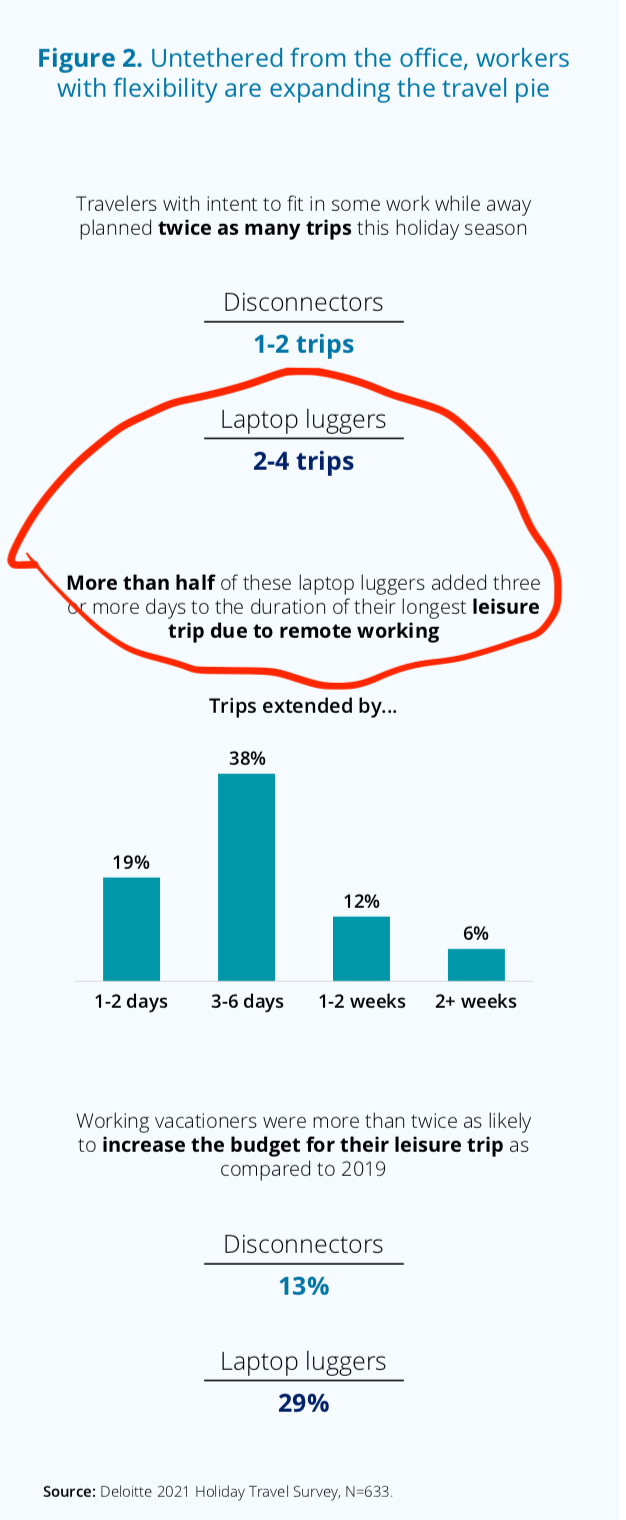
This merged world of work and travel is now driving the comeback of business travel a lot faster than many of us imagined when we first entered our lockdown life. And it is expanding the travel pie, which is what a recent survey by Deloitte pointed out, best illustrated by this chart from the report in Figure 2.

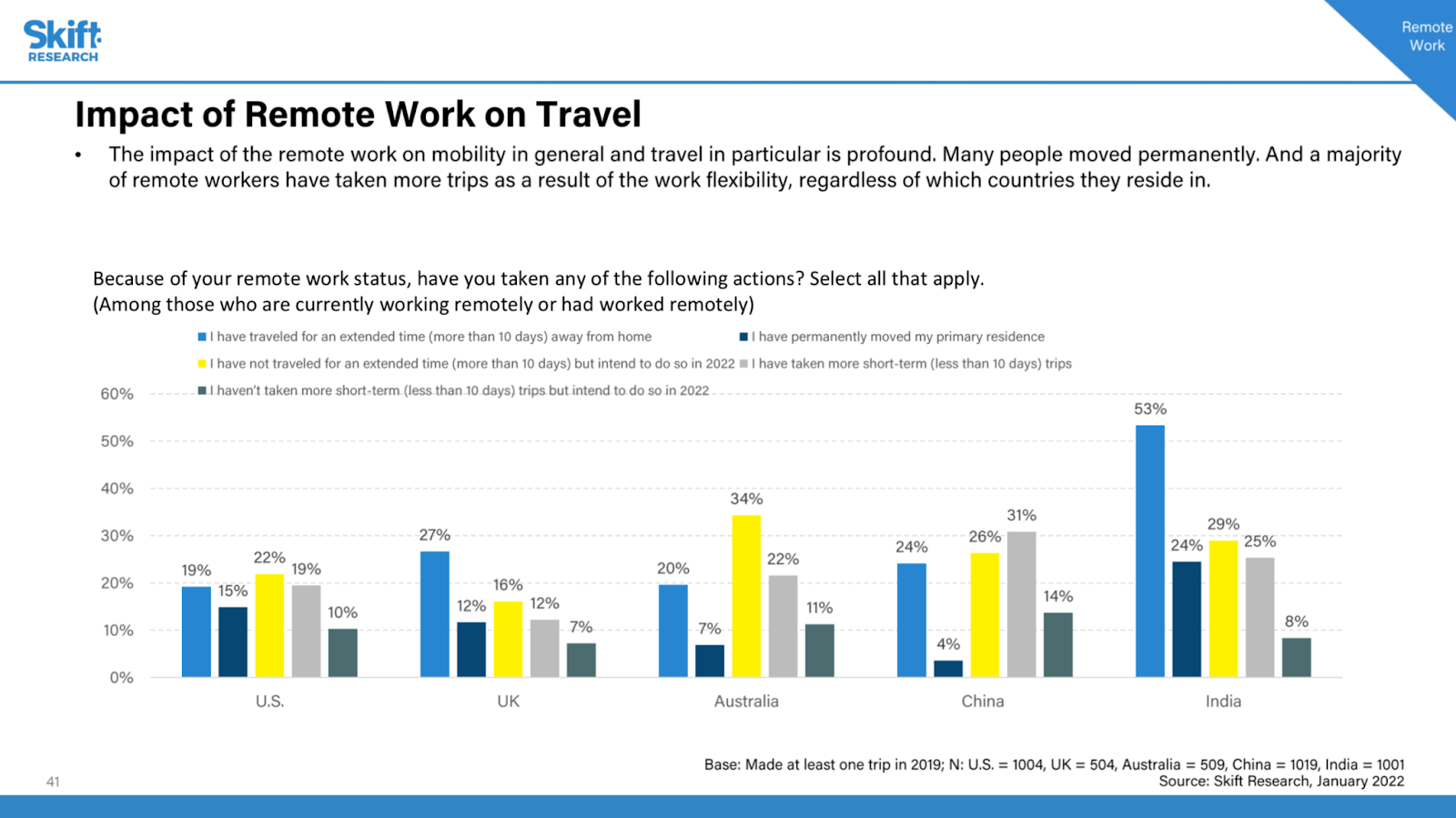
Our own work at Skift Research has also unearthed evidence of this around the world, as this chart from our five-country study reveals, the main takeaway being that the majority of remote workers have taken more trips as a result of work flexibility, regardless of the countries they reside in.
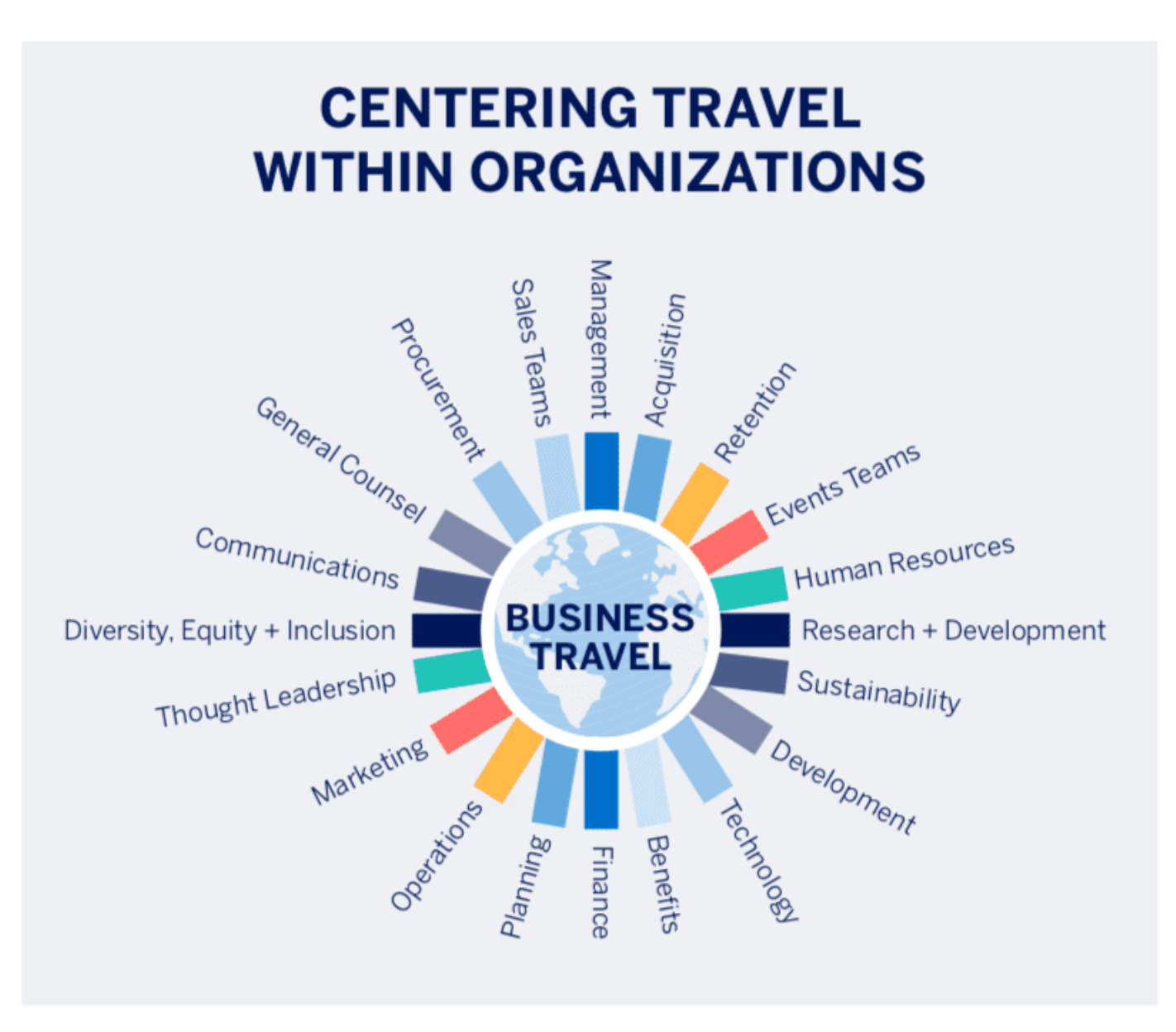
This Great Merging is also showing up in a distributed work world, where companies large and small are figuring out how to center travel as a way to build company culture, what AMEX GBT calls “centering travel within organizations is the way forward to reframe business travel from a transactional mechanism to a transformational tool.” A recent white paper from the company has a handy chart that illustrates this role of merging travel into everything a company does, across departments and functions.
As for the cliche of digital nomad lifestyle, it is becoming increasingly a reality beyond just the digital nomad visas launched by many destinations during the last two years, including early adopter Bermuda, Barbados, Puerto Rico, Estonia, Mauritius and more. There are efforts like this one in Europe that are trying to push for a pan-European digital nomad visa. Such a visa would have the potential to unlock vast amounts of travel, as well as knowledge exchange, enabling remote workers to travel freely through Europe, the backers argue. 

More nuances are emerging from cross-collaboration of previously separate sectors of travel in this Great Merging, with evidence emerging in new collaborations between resorts and accommodation providers to help full up low-seasons with digital nomad travelers. A good example is Austria-based Falkensteiner Hotels & Residences which has teamed up with Grabahome, and is looking to fill its properties with remote workers during the low season.

Even the hotel owners and investors are getting in the game, and the latest move from Pebblebrook Hotel Trust, which owns about 55 hotel and resort properties across U.S., speaks to it: it is adding treehouses, glamping units, teepees and villas in its portfolio, some as part of its existing resorts where they have ample space, and considering standalone in the future. One example: the company-owned Skamania Lodge was built as a conference center when large corporations would hold off-site training sessions on a regular basis. “As more training moved online over the last decade, Pebblebrook has transformed the property into a more leisure-focused, experiential resort. Now it is spending about $10 million to $12 million for three new treehouses, glamping units, a multiple-bedroom villa and a pavilion on property,” reports HNN.

From the story, quoting Pebblebrook CEO Jon Bortz: “The world evolves, and consumer tastes and desires evolve … I think we have to evolve with it … We’re following the customer and the whole idea of experiential travel, which is why we have so many independent, unique experiential properties.” What hotels do and what companies such as Airbnb do are melding together, and the line between the two continues to blur, he said. As Pebblebrook adds cabins or villas, it may decide they can only be reserved on a weekly or monthly basis, becoming more like a vacation rental than a typical hotel, he said.

One of the biggest implications of this Great Merging is on how the travel product offerings get broadened and merged, and travel brands should be prepared to offer services across the full travel value chain, including transportation, accommodations, in-destination activities and food and beverage. The early trend towards travel subscription offerings — and the best kind of recurring revenue for travel companies — is where these are showing up in the most potent ways. 

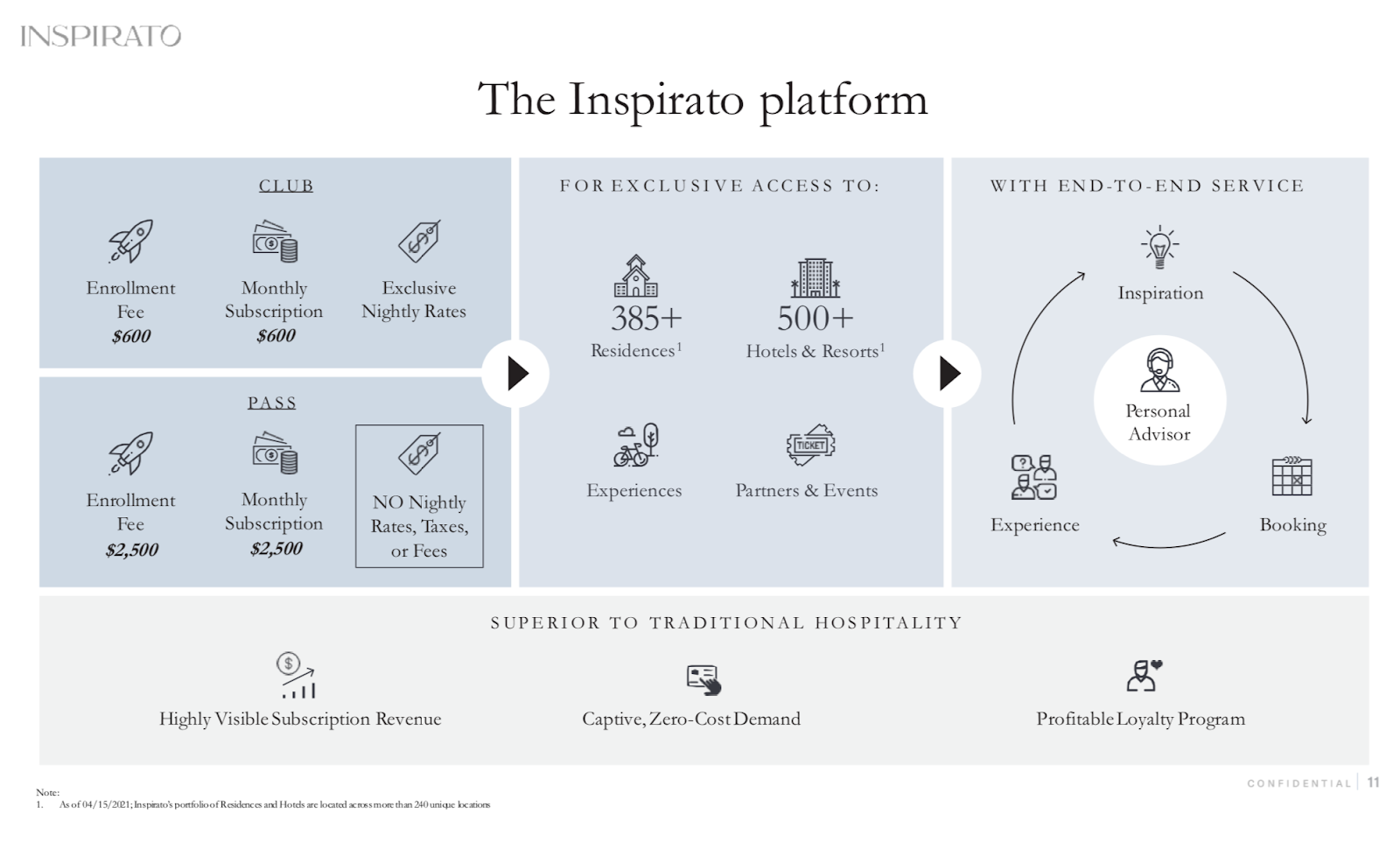
Inspirato, the luxury travel subscription service is the purest-play example of this, where this slide below from its recent deck as it went public on the stock market shows the end-to-end product integration that these services allow, in many ways inverting the travel purchase cycle we wrote about at the start of this essay.
The Big Questions in a Merged World

Things are all changing so fast that it is hard to have definitive answers of the implications of The Great Merging and how it manifests in travel behaviors, especially as the specific travel behaviors have blended in with living and working behaviors. What we do know is that the travelers are in charge and what most travel brands can do is learn from their own lived experiences and from their customers. The key word here is “lived.”

So what are the big questions, the big unknowns of The Great Merging?

  • Will the Great Merging enable more travel, or more efficient travel, or both? What will its impact be on climate change and the building backlash against travel’s extractive effects on the planet?
  • What will be the next phase of personalization in travel for these blended personas?
  • How will travel companies across the spectrum respond and offer services in the big business of enabling company culture beyond the early examples outlined in the essay above? 
  • How will customer service adapt in this new landscape and what type of new talent will be needed in the travel industry?
  • What opportunities exist for investors and developers across sectors?
  • Will the digital nomad visas really move beyond early adopters and countries already heavily dependent on tourism to a more mass adoption and what services will emerge to cater to this?
  • Will the real estate investors start to invest across the spectrum of merged accommodation assets? We have already seen some early evidence of it but nothing at scale yet?
  • How will design change for offerings all across the travel ecosystem beyond just thinking of mixed-use as the metaphor?
  • How will online travel agencies move beyond the traditional stronghold of transient leisure world and actually build services that cater to this breadth of merged traveler personas?
  • Will hotel players besides Accor and Marriott become more serious about expanding their portfolio of accommodations beyond hotels?
  • Will the short-term rental players adapt to add more hospitality offerings beyond just new forms of stays?
  • How will the economics of airline industry change long term, beyond the American Airlines example? If premium leisure is a real long-term thing, how will marketing and sales of upper class offering change in the sector?
  • In an era where off-peak demand is now increasing and people are living and traveling in non-traditional ways beyond peak days, how will demand and its prediction change?
  • How will the meetings and events industry change where people are not just asking for more experiential offerings but also mixing events in their personal lives deeper ways than previous?
  • Will travel companies walk the talk on the dream of live-work-travel anywhere that many have been selling explicitly and implicitly over the last two years? Airbnb was the first major travel company out with its policy of effectively going permanently remote.
  • Will tour companies move into the corporate retreat space?
  • What new forms of travel subscriptions services emerge that cater to this blended personas and needs of travelers?
  • How will this blended world expand the offerings from travel agencies and their advisors, and vice versa for the corporate travel agencies?
  • Will the ongoing financialization of travel help resulting in more seamless payments solve the challenges of distributed workforce and the resultant travel that happens globally? 
  • How are the incumbents reacting to this new blended world, and what can we learn from the new challengers in this ecosystem?

Those are just 20 questions – and so many more to come – whose answers will reveal themselves, some sooner than others. The travel brands that will succeed in this Great Merging will either have to specialize on the one thing they do well, or expand to span multiple travel categories, being in the middle is not an option.

The only certainty as we stand here today is that all the threads have been coming together for years, and a jarring pandemic offered us the clarity to see travel’s distinctive lines and barriers fade forever.

[ad_2]

Source link

Motion de blâme contre le GM : XLD liste les inquiétudes citoyennes

[ad_1]

Le leader de l’opposition a, lors de son allocution dans le cadre de sa motion de blâme (Motion of no Confidence) contre le gouvernement, brossé un sombre tableau de l’état actuel de l’économie mauricienne, ainsi que de son avenir. Et ce, en s’appesantissant sur des rapports d’institutions respectées, comme le Fonds Monétaire international, la Banque mondiale, la Mauritius…

[ad_2]

Lisez la suite:

Le Mauricien

Have something to say? Leave a comment:

Kenya Tourism Weighs Cost of Introducing Electric Vehicles to Wildlife Parks

0

[ad_1]

Kenya recently announced that its national parks and game reserves will only allow non-fossil fuels to access it national parks and game reserves by 2030. In addition, all hospitality and tourism facilities will be required to adapt renewable energy and circular economy in their operations. The cabinet secretary for tourism in Kenya stated that this was a necessary move being that Kenya is a founding member of the newly launch of sustainable tourism global center.

But the move will come with enormous challenges — mainly the cost of electric vehicles in Kenya’s storied park lands. 

This comes as the industry confronts that transportation is tourism’s main source of greenhouse gas emissions. On average, planes and cars generate the most CO2 per passenger mile, with tour buses, ferries, and trains coming well behind.  Following the recent United Nations climate change summit in Glasgow, nearly 200 countries have committed to revisit and strengthen their 2030 emissions reductions plans next year, keeping the door open to the crucial 1.5°C temperature goal.

Kenya highly relies on tourism and rainfed agriculture which unfortunately are both susceptible to climate change and extreme weather events. Kenya’s carbon dioxide (CO2) emissions amounted to roughly 16 million metric tons in 2020, down from 18.3 million metric tons in the previous year, according to Statista,. Despite this decrease, there has been an increase in the volumes of emissions from fossil fuels and industry in the country since 2000. And for this reason, it is necessary for the government to take the necessary steps and ensure sustainability to mitigate the adverse effects of climate change. 

The move has been received with mixed feelings amongst the players. Gerard Beaton, director of operations for safari operator Asilia, said that camps have, for a long time have run on solar power, and banned single-use plastic, and that replacing the fuel guzzling engines of the safari cars is the last step. 

“We charge our electric cars from our solar plant so our game drives really do have considerably lower emissions over their lifetime than conventional (internal combustion engine) vehicles,” he said.

‘Huge Financial Outlay’ 

Despite that this is a worthy initiative, the prospect of the costs weighs heavy.

“This is a huge financial outlay for our national parks after two years of almost no revenue. But Kenya would be setting an incredible example to the world of how to care for its wild places. We already have a ban on single use plastic in the conservancies, (moving) to only have electric cars would be truly setting a global standard,” explained Beaton.  

He also adds that it will be a great initiative only if the vehicles will be charged from solar plants. 

“It is essential that we use renewable energy sources. As per the above, electric safari vehicles not only enhance the guest experience they are also better for the environment. I saw that Uber will be introducing 3,000 electric motorcycles in Nairobi — this is going to make a huge difference to the quality of life in the city with reduced noise and emissions,” he said. 

 For Asilia, the shift to electric safari car really was the final piece in the jigsaw of having a low footprint safari operation. Their first electric safari car began with Ol Pejeta Bush Camp in August 2019 and converting the safari car cost Asilia $37,000. This, according to camp officials, was a significant initial cost which for many companies after two years of Covid-related reduced revenues will be hard to find. However, Opibus (now ROAM), the company that built Asilia’s electric safari vehicles, estimates that by running an electric safari vehicle, players in the industry will save $7,000 in fuel and service costs so it will take us 5 years to break even. Despite the cost, Beaton said that this has revolutionized their guest experience. 

“Keen photographers are particularly enthusiastic about the car as the ride is much smoother and there are no longer bump gear changes — making for ideal photography conditions. It is also quieter making it easier to enjoy the sounds of the bush,” he noted.

For Emboo, the first lodge in Kenya and beyond that has its entire fleet of Safari Vehicles powered by solar energy, the vision of sustainability began from the onset when they began operations in the country. For them, having the electric safari vehicle has offered a unique way to explore the Masaai Mara. 

“The vehicles are solar powered, silent, have no exhaust fumes and do not disturb wildlife. You will be able to enjoy safaris while listening to the sounds of nature, enjoying the scents of the savanna and getting close to their favorite animals without disturbing animals. You can truly be part of nature,” said Valery Joanne Super, director of sales and marketing for the Emboo camp. 

She added that the electric vehicles increase the tour guides’ sighting opportunities as they can now use all their senses while guiding. 

“Recently, guests went on a game drive when the guide heard a soft roar in the distance. The sound would normally not be heard over a standard engine. The guide drove towards the sound and found a leopard with cubs in the bushes which the guests enjoyed,” she continued. 

While the upfront investment is higher, Valery noted that its operational costs are much lower and this makes it a business savvy decision.

“On top of being the right thing to do for our community and ecosystem, the vehicles, do not need fuel and the maintenance is minimal. As you will have noticed, the fuel situation in Kenya has led to high prices and shortages of fuel at stations, lodges with old ICE (internal combustion engine) vehicles or with generators powering their fridges, lights is experiencing range anxiety due to this. Those that have electric vehicles are just fine,” she said. 

Innovation Hub to Inspire

As a result, the camp now has an innovation hub in the Masaai Mara to inspire, and train other tourism players on sustainability. They also receive a roadmap on how to develop their own sustainable business, community center or daily lifestyle. 

“Emboo River is offering consultancy to help businesses in the tourism space and beyond to make their operations sustainable. It is better for the environment, smooth business operations, cost savings, being independent from world events and price increases and we’re here to help others make this shift,” said Valery. 

Though he is confident that electric is the way forward and is looking forward to seeing improvements in the country specific to game drive vehicles. Mohanjeet Brar, managing director of  Gamewatchers Safaris, hasn’t made the shift yet since it hasn’t made any financial sense to his business. 

“Unfortunately Kenya doesn’t seem be benefitting from the lowered costs of battery/solar tech yet. Also my friends that bought them are having some challenges and the battery life isn’t sufficient for some. It is almost double the price of a new vehicle once you factor in the cost of the charging facility in the camp. Of course, if you’re having to use a generator to charge the car then it completely defeats the purpose,” he said. 

For John Musau, general manager of Tamarind Tree Hotel, this directive will be an expensive affair since most of the tour operators taking their guests to the Nairobi National park, which is a few minutes away from the hotel, have both diesel and petrol tour vans.

“The main negatives are high cost of maintenance and purchase which will render lot of local tour operators and hotels jobless. Our hotel will for sure be affected because majority our clients want to do day trips to Nairobi national park. If we will not have such vehicles, then it means we will not be as attractive to foreign tourists as we are currently,” he said. 

[ad_2]

Source link

Allianz and Marriott Are Reimagining Travel Insurance for the Hotel Guest

0

[ad_1]

The hospitality sector continues to rebound post-pandemic, as travelers make up for lost time by booking all types of trips. Whether seeking hotel stays for international “bucket list” vacations, local weekend getaways, or week-long workcations, travelers are gravitating toward hotels that offer booking flexibility and generous cancellation policies — but many travelers don’t take the time to research and select a travel insurance policy for their hotel.

Allianz Partners, which has a long history of serving travelers across the globe, recognized this opportunity last year when it collaborated with Marriott International, becoming the first company outside of smaller all-inclusive brands to offer insurance directly within a major hotel chain’s booking platform. The collaboration allows Marriott to offer its guests added trip protection when booking their hotel stay through the Marriott website and the iOS version of the Marriott Bonvoy mobile app.

To learn more about how the companies are working together to enhance the guest experience while also driving ancillary revenue, SkiftX spoke with Tom Trotta, vice president of sales and partnerships at Allianz Partners, and Peggy Fang Roe, global officer, customer experience, loyalty and new ventures at Marriott.

SkiftX: How does Allianz Partners leverage its advantages as an established financial institution and a nimble innovator to adapt to changing traveler trends coming out of the pandemic?

Tom Trotta: We quickly added temporary claims accommodations when the pandemic began to help travelers who became ill with Covid either before their trip began or while they were traveling. We’re proud that we were able to move quickly to address what was a fast-moving, evolving situation. While losses due to epidemics were fully excluded from coverage at the time, taking care of our policyholders was the right thing to do for them and for our industry partners.

During that time, we also put additional accommodations in place to provide customers with refunds of their travel insurance premium when their trip was canceled by their travel supplier due to Covid. Since then, we’ve enhanced our product portfolio with new coverage for several epidemic-related situations — this coverage is now available in most states. We continue to leverage our capabilities to develop new products that help our customers who are now navigating a new normal. Additionally, our free TravelSmart app includes resources to help travelers with features such as real-time travel alerts, vetted medical provider locators, and medical translations to help them before and after they arrive at their destinations.

SkiftX: What’s unique about the collaboration between Allianz Partners and Marriott?

Trotta: We’re thrilled to be working with Marriott to offer exciting new products, including one policy that can cover everyone staying in a room, even if they are not on the reservation, for covered events that may unexpectedly arise before or during a customer’s trip. These new products provide reimbursement for prepaid, non-refundable expenses beyond just the cost of the room, up to the limit of the policy.

In situations when the property’s cancellation penalties are not a concern for their guests, other products may cover — subject to the plan’s terms, conditions, and exclusions — in-trip issues like lost baggage, missing items, and trip delays and interruptions. For international trips we add coverages like emergency medical and dental, medical evacuations, and individually ordered quarantines. Our insurance products and assistance services provide additional confidence many guests may need to book their next trip.

SkiftX: Why is travel insurance particularly valuable for Marriott guests today, and how does Marriott meet guest needs with its insurance strategy?

Peggy Fang Roe: Taking care of our guests while they explore the world has always been a core principle for our company, and today’s less predictable travel environment has made the need to protect travel decisions more urgent.

Together with Allianz Partners, we are designing new and innovative ways to provide guests with confidence and peace of mind when they travel. Allianz’s industry-leading product provides protection for all travelers in the party and protects trip purchases beyond the hotel stay, which is a true game-changer. This new travel insurance product is another example of how we are transforming to provide more thoughtful benefits and value to travelers across their entire trip.

SkiftX: The guest experience begins with booking, which travelers increasingly expect to be seamless and personalized. Why was it important to offer the ability to buy insurance directly in the purchase path?

Fang Roe: You are absolutely correct; customers are increasingly expecting guest experiences that are seamless and personalized, and this includes providing insurance options that fit guest needs. That’s why we’ve worked with Allianz Partners to curate a range of policies that vary in price, coverage, and benefits that are easily available for purchase at the time of booking. This can help save travelers valuable time and effort.

SkiftX: How does Allianz Partners ensure that it is surfacing the most relevant offers and experiences alongside its hospitality partners during the booking process?

Trotta: Our e-commerce booking platform, known as Fusion CORE, is a state-of-the-art technology solution that helps optimize a personalized insurance offer for each guest’s reservation, all within a fraction of a second. This saves guests time and helps get them the coverage that best meets their needs. The fact that our products cover everyone in the room can also provide a tremendous cost saving for travelers who might otherwise have to cover each individual separately on their insurance policy.

Our marketing optimization program has been successful at creating a more personalized experience and driving happy customers. Working closely with our broad mix of partners, we take a data-driven approach to foundationally understand customer behavior, then methodically and continuously improve a customer’s experience through experimentation. Our program utilizes over 900 unique, evolving customer segments while conducting over 1,500 experiments per year. As a result, our team of experts is able to drive double-digit insurance revenue growth with partners each year.

Our technology and optimization strategies allow for near unlimited flexibility on where and how we offer our products. We are able to dynamically offer different products based on factors like booking windows, lengths of stay, destination or destination groups, trip costs, membership status, frequency of travel, and more — essentially, any data element or derived data element available to the platform.

SkiftX: As Marriott’s loyalty strategy evolves, how does the company plan to expand its travel insurance offering?

Fang Roe: The travel insurance space is a huge growth area. We want to maximize the opportunity in the U.S. as well as expand the offerings to guests residing in other countries such as Canada, key European markets, and more. We also want to identify the most effective products to complement our current offerings, such as annual travel insurance plans, event cancelation, and more.

SkiftX: What additional value can Allianz Partners bring to hospitality brands, and how does the company hope to expand its collaborations in the hospitality space?

Trotta: Marriott is a pioneer with us in this space, so we look forward to continuing to grow with them. We’re working with other brands in the hospitality space, including timeshare companies, a luxury alternative accommodations provider, luxury cruise lines, and tour operators.

Our value is not just from this broad base of growing relationships, but also from our ability to respond to changing traveler needs and responses to our products and offers. We conduct surveys of over 2.5 million customers per year in addition to leveraging over 166 billion data points to understand and predict trends. We pride ourselves on being the original “insurtech” company.

For more information about Allianz Partners, please visit AllianzAdvantage.com. To learn more about Allianz Partners’ travel insurance products offered through Marriott, visit TravelInsurance.Marriott.com.

Terms, conditions, and exclusions apply to all plans. See Details and Disclosures.

This content was created collaboratively by Allianz Partners and Skift’s branded content studio, SkiftX.

[ad_2]

Source link

Pouvoir…D’achat — En prélude au ticket de bus : L’inflation s’affiche à 11 % en avril !

[ad_1]

Après avoir franchi la barre de 10% en mars, pour s’établir à 10,7%, le taux d’inflation atteint maintenant 11%, selon les derniers relevés de Statistics Mauritius pour le mois d’avril. Cette poussée est en avant-goût à la revision à la hausse Ganoo du ticket de bus avec Statistics Mauritius soulignant que « Year-on-Year inflation worked out to 11.0% in April 2022, compared to…

[ad_2]

Lisez la suite:

Le Mauricien

Have something to say? Leave a comment:

Rose Hill, Mauritius

0

Rose Hill, Mauritius #mauritius #mauritiuscountry #walkingtour #mauritiusisland #rosehill.

source

Have something to say? Leave a comment:

Here’s Why Travel & Expense Spend Is So Hard to Manage

0

[ad_1]

As companies focus on reconnecting with clients, vendors, partners, and even employees they haven’t seen face-to-face in two years, business travel is coming back in a big way. For travel managers, though, the return may include a bumpy — and more expensive — ride.

A big reason: The time spent reviewing and managing employee expenses has risen dramatically over the last few years, but for many companies, the travel expense submission and approval process remains overly cumbersome and antiquated. This is especially true as digital and contactless payments move into the mainstream.

“Before the pandemic, I would get maybe two daily alerts when travelers were booking rates that exceeded policy limits,” Holly Bemrose, travel manager, RWE Group UK, Ireland and Asia, told Skift. “I’m getting about 20 each day now.”

Bemrose said the company has approximately 2,000 regular travelers, and she expects its global travel spend to be somewhere between $19.5 million (£15 million) and $26.1 million (£20 million) this year. Those alerts she has been receiving point toward the higher end of that estimate. For example, one UK hotel that RWE’s travelers frequent used to average $119 (£91) per night. Now, that average is closer to $156 (£120) per night.

“I’m definitely seeing that suppliers are trying to reap back some of the money they lost,” Bemrose said. “I understand why. It’s happening across the entire travel industry.”

The increase in costs is about to make a hard job even harder for Bemrose’s peers in the corporate travel landscape, which TripActions explores in a new report, “How Businesses Can Scale Travel & Expense Policy.” As stated in the report, a recent survey of finance leaders conducted by TripActions shows that travel and entertainment is the sixth-largest category of spend for companies — yet it’s the most difficult category to manage.

What’s the secret to making this hard job easier?

“We hear a lot of frustration from companies that have cobbled together separate systems for travel booking, corporate cards, and expense management,” Kate McCarthy, vice president of user experience at TripActions, told Skift. “They’ve made it work, but not without endless headaches. One problem is that travelers don’t always know what’s in-policy for them. This means that finance teams have to spend a lot of time reviewing expense reports and may end up rejecting some expenses, which is a frustrating experience for everyone involved.”

Keeping Employees Happy

Managing travel expenses isn’t just about the bottom line. In the midst of “The Great Resignation,” it’s also a crucial way to create a more positive experience for employees who are tired of the inevitable paperwork trail that follows their work travels.

“One of our biggest [historical] complaints was the process of submitting expenses,” Bemrose said. “These employees had to spend time away from their friends and family, and then, they had to come into the office and scan their receipts within a certain time frame. Sometimes, the trip didn’t feel worth it because they would spend so much time completing their expense reports.”

Of course, streamlining spend for travelers is just part of the struggle — finance teams then have to reconcile incurred expenses, which can take significant time.

“No one wants more paperwork or busywork,” McCarthy said. “Not travelers, and not the finance team that has to process the expenses. Any time you can reduce annoyances for employees, the happier they’re going to be. And right now, in this competitive hiring environment, companies need every advantage they can get to attract and retain talent.”

Yet despite the need to reduce inefficiencies and eliminate cumbersome processes, many companies have failed to prioritize that reduction of annoyances. As a result, plenty of finance leaders are still using an outdated approach to travel and expense, including line-by-line reviews of costs and an equally lengthy waiting period for employees who need to be reimbursed — and it’s holding back their business.

Listening to Travelers and Adopting New Solutions for Travel, Corporate Card, and Expense Management

So what’s the trick to increasing those satisfaction levels? It starts with something simple: Listening, which is something that Bemrose has been able to do during the past two years of uncertainties.

“Before the pandemic, travel was a system,” she said. “When it worked, it worked. When it didn’t, our travelers would shout about it. During the pandemic, I was suddenly talking to them and spending time on the phone with them. It created a really good relationship with my frequent travelers. Rather than just looking at booking travel and submitting expenses from a strategic, data-focused level, I’ve been able to learn about individual pain points and how to make life easier for them.”

In addition to listening, companies can also increase happiness with travel management by helping get rid of the need for any extra back-and-forth communication. And reaching that goal begins with policy enforcement. As McCarthy said, travelers don’t always know what’s in-policy for them, which can cause a spike in out-of-policy spend, like the one Bemrose has seen.

Enforcing policy, in turn, makes it easier for the finance team to do their job. And even though many companies are not yet taking advantage, there is a way to make enforcing policy seamless.

Consider IoT company Relayr, a TripActions customer that, said McCarthy, can approve 98 percent of its booking expenses with no back-and-forth, no alerts, and no reimbursement forms. “Their travelers don’t have to worry about after-the-fact rejections, and their finance team doesn’t have to go line-by-line to approve expenses anymore,” McCarthy said. “It’s truly a win-win.”

What’s the key to streamlining travel and expense processes — and how can that give you a jump on the competition?

This content was created collaboratively by TripActions and Skift’s branded content studio, SkiftX.

[ad_2]

Source link