
[ad_1]
Skift Take
Talk about eye candy. In our first-ever list of top hotel design firms, we spotlight the interior designs and architectural masterworks that are making hotels more comfortable, sustainable, and breathtaking.
The hotel industry is emerging from a rough pandemic, so it’s a good time to celebrate a brighter future driven by hospitality innovation. We scoured the globe to find some of the best talents in hotel architecture and interior design. These 15 firms represent a diverse mix of influences and philosophies. Some are up-and-comers, while others are legends. All of them know how to use next-gen innovation to make travelers happier, whether it’s at a limited service property, a luxury resort, or a tented hotel.
Denniston
Architects, planners, landscapers, and interior designers
Location: Kuala Lumpur, Malaysia
Notable projects:
Key People:
Jean-Michel Gathy, principal
Success for Jean-Michel Gathy has always been a little bit about luck — and a lot about pluck. Just after graduating from college in the early ‘80s, his work caught the eye of Adrian Zecha, founder of Aman Resorts. Four decades later, the clientele of Gathy’s firm Denniston is a Who’s Who of the most esteemed brands in five-star hospitality, with 34 properties in 20 countries. Gathy, a native Belgian, has done most of his work in Asia, where he completed the Four Seasons Bangkok at Chao Phraya River in 2020. That property is one of the truest representations of a vision that’s difficult to achieve, in Gathy’s view: the “urban resort.” Four large courtyards and a riverwalk provide guests with an oasis. “You completely forget you’re in the middle of Bangkok, one of the busiest, animated, lively cities in the world,” he said.


Notable Projects:
Key People:
Rob Blood, principal designer
Megan Kennedy, principal designer
There’s education, and then there’s instinct, according to Elder & Ash principals Robert Blood and Megan Kennedy. Neither half of the duo has formal design training. But what the business and life partners do have is many years of experience in working “almost every role in a hotel,” said Kennedy. For Blood, that included a post-college stint running a small inn; today, he’s just as comfortable running business operations as selecting and installing wallpaper or hauling furniture. Elder & Ash is the in-house design firm for Massachusetts-based boutique brand Lark Hotels, where a Scandinavian aesthetic is fused with millennial-friendly nostalgia. Guests frequently use QR codes with design notes for each property to imbue their homes with similar vintage finds, whimsical prints, and pops of color. “Because we have the opportunity to design spaces that people live in for only a short time, we’re able to push boundaries and spark people’s imaginations,” she said. “It’s really exciting to tell the story of a building/place through design.”
-

This interior was designed by Elder & Ash for AWOL Kennebunkport B&B. Photo by Read McKendree. Source: Elder & Ash. -

This hotel interior was designed by the firm Elder & Ash for the Lark Hotel Blind Tiger in Portland. Photo by Read McKendree. Source: Elder & Ash. -

This interior was designed Elder & Ash for the AWOL Kennebunkport B&B. Photo: Read McKendree. Source: Elder & Ash.
EDG Design
Hotel and resort design, brand strategy, food and beverage
Location: California, Texas, Singapore
Notable projects:
Key People:
Jennifer Johanson, president and CEO
Hospitality is no foreign concept to Jennifer Johanson. The president and CEO of EDG Design cut her teeth designing restaurants, and her career – and firm – have evolved globally after working on Four Seasons F&B projects in Prague, Riyadh, Budapest, and Shanghai. Those made EDG the favored choice to bring Appellation to life, a new “culinary-first” hotel brand from celebrated chef Charlie Palmer and former Four Seasons executive Christopher Hunsberger. The partnership reflects her ethos and “experiential storytelling,” Johanson said. An open kitchen and floor-to-ceiling windows with panoramas of Sonoma wine country in Healdsburg, California, provide an immersion of the senses. Bringing the outdoors in is one of EDG’s hallmarks, whether it’s Luxury Suites — “cabins” dappling the verdant landscape in Chiang Mai – or five-star glamping at Terramor Outdoor Resort in Maine. Good design is an artful “narrative,” said Johanson. “A compelling script sets the tone for the whole story. Design touches everybody differently and is truly inspirational when a deeper story beckons us deeper into the experience.”


Notable projects:
Key People:
Carl Almeida, partner
P49 Deesign principal Carl Almeida’s recent new build with Sofitel Adelaide wasn’t exactly a complete 180-degree spin from the projects – like Chiang Mai’s 137 Pillars – requiring architectural historians and conservationists for which his firm is renowned. Embellishments across the modern luxury hotel pay homage to the Old World with whimsy. “Our vision was to bring to life three quintessential Adelaide themes – city of churches, arts and culture, and wine – and to weave these narratives into the hotel’s contemporary interiors, all of which are also a nod to the hotel’s cultural link to the city of Bordeaux in France,” said Almeida. His upbringing in Adelaide made him a natural choice for Sofitel’s debut in South Australia, although most of Almeida’s – and P49’s — portfolio spans Thailand and the rest of Asia.


Notable projects:
Key People:
Bill Bensley, founder and principal
A love of the outdoors and nature comes easily to Bill Bensley, who was raised on a farm and studied as a landscape architect. But it wasn’t until he earned a master’s from Harvard’s Graduate School of Design that he backpacked across Europe, hitchhiked through Malaysia, and worked across Asia when a deep love of travel – and hotels – took hold. Landscapes are the true canvas for his design atelier. They’re the focal point instead of the backdrop in a portfolio rife with tented camps and gardens — fit for the “Willy Wonka” of horticulture. His own Shinta Mani Wild, a tented luxury camp in the Cambodian rainforest, is just one of many examples where Bensley structures dapple a landscape in a way that lets hotels harmonize with nature. Sustainability is one of Bensley’s core priorities. It factors heavily into one of his next projects: InterContinental Hotel Kao Yai Resort in Thailand. There, guests can expect to find upcycled train carriages reimagined as suites after the second phase of the hotel’s opening this year.


Notable projects:
Key People:
Olga Hanono, principal and founder
As an interior designer who began building her portfolio with luxury residential projects, Olga Hanono has been able to take creative license and indulge clients with a panoply of patterns, colors, textures, and eye-catching light fixtures. But she’s cheered by a recent move toward hoteliers developing with fewer keys, which lets brands offer guests more of a “home away from home” feel. This intimacy marries form and function for a “bleisure” guest, and Hanono keeps “multi-purpose” top of mind in her work, such as in a pandemic project called The Next Hotel. “We sleep, play, eat and work in the same space now, so we have to change everything from technology to lighting to have a nice experience,” Hanono said. “We don’t want our desks facing the wall and the laptop camera to face the bed. There are new needs and activities to embrace and incorporate these days.”
-

This hotel space at the La Santísima Trinidad, near San Miguel de Allende, Mexico, was designed by OH Studio. Source: OH Studio. -

This interior hotel space at the La Santísima Trinidad, near San Miguel de Allende, Mexico, was designed by OH Studio. Source: OH Studio. -

This interior hotel space at the La Santísima Trinidad, near San Miguel de Allende, Mexico, was designed by OH Studio. Source: OH Studio.
Luxury Frontiers
Interior architecture, interior design, advisory services
Location: San Francisco and Johannesburg
Notable projects:
Key People:
Luca Franco, co-founder and CEO; Nadia Ghillino, head of interior architecture and interior design
When Naviva resort opens adjacent to Four Seasons Punta Mita in late 2022, it will bear some extraordinary differences with the main property – notably, the fact that there are no traditional “walls.” Instead, the 15 luxury tents blur the line between indoor and outdoor, creating a constant immersion in nature. The concept will surprise no one familiar with Luxury Frontiers. The South African firm’s imprint spans some of the most opulent tented camps around the globe. Nadia Ghillino, head of interior architecture and design, said the thread tying together each project – “whether that’s showering under the canopy of a tree at Nayara Tented Camp in Costa Rica or sleeping under a blanket of stars at Puku Ridge in Zambia” – is contextuality. “For a design to be good design, it needs to be well-grounded in its place. And place extends beyond location to include attributes of culture, operational goals, environment, vernacular influences, the tangible and intangible,” Ghillino said. “If we can get that right, the magic is there for the guest.”
-

The infinity pool at a Nayara Tented Camp designed by Luxury Frontiers for the Naviva Four Seasons Resort Punta Mita, Mexico. Source: Four Seasons Hotels. -

The Nayara Tented Camp was designed by Luxury Frontiers for Naviva Four Seasons Resort Punta Mita, Mexico. Source: Four Seasons Hotels. -

The Nayara Tented Camps, shown here, were designed by Luxury Frontiers for Naviva Four Seasons Resort Punta Mita, Mexico. Source: Four Seasons Hotels.
Notable projects:
Key People:
Kate Mooney, founder and design director
When Marriott needed a crowd-pleasing aesthetic, it turned to Occa Design. It tasked the firm with balancing Northern European simplicity and vibrant accents from Southern Europe when the global powerhouse launched its Fairfield by Marriott prototype tailored for Europe and the Middle East. The Copenhagen launch of the new Fairfield perfectly balances the contemporary and the comfortable for business and leisure travelers thanks to the Occa team’s use of natural materials and the connection between the indoors and out with natural lighting. Founder Kate Mooney is no stranger to the impact of texture and textiles thanks to having gotten her start by working in her family’s business — specializing in manufacturing soft furnishings for hotels. Today, that early expertise has been amplified with skill at curating furniture and lighting design services and internal architecture for many well-known brands outside the Marriott universe, including Hampton by Hilton, Crowne Plaza, and Holiday Inn.


Total Integrated Design (India)
A global interior design firm whose work includes hospitality, such as business hotels, resorts, and serviced apartments.
Location: Gurgaon, India-based studio with partners in Singapore and Malaysia (TID International P L)
Notable projects:
Key People:
Ritu Bhatia Kler, managing director
Ritu Bhatia Kler started the India office of this Singapore-founded company in 1995. Since then, TID India has become a hotel design specialist for renovations, conversions, new build bespoke properties, and brand prototyping, such as for Ibis in India. “Lighting plays an integral part of design, and at TID, we consider it sacrosanct,” Bhatia said. “Light can be used to create focal points or be art itself.” The studio also researches the attributes of a surrounding location to make sure the hotel’s design provides a relevant sense of place. Think of rugs echoing patterns found in locally renowned cloth weaves. “Art and artifacts can set the mood and tell a story,” Bhatia said. “We ensure each design is distinctive with a variety of decorative items used such as maps and globes, sepia-toned photos, and object-oriented decor.” TID India has a long-standing embrace of integrating design with functionality, a practice first championed by one of the Singapore Partners, Gregory Pong. The firm also likes printing an artistic theme or graphics on mediums such as wallpaper, film, or glass to help underscore a property’s uniqueness.
-

A suite designed by TID International (India) for Radisson City Centre Bengaluru. Source: TID International (India). -

A lobby and lounge designed by TID International (India) for Courtyard Marriott Madurai. Source: TID International (India). -

A lobby for the lifts, or elevators, at Ibis Mumbai Vikhroli. It was designed by TID International (India). Source: TID International (India).
Notable projects:
Key People:
Yoav Messer, founder
Connecting to a sense of place is important for Yoav Messer. “For every project that we take on, it’s highly important to us to incorporate the cultural background of the place where it is located,” Messer said. Take, for example, the Ink Hotel in Tel Aviv. It was built on a site after a library dedicated to Yiddish literature was demolished. Messer ensured that the new building’s exterior resembled a stack of books, with their pages simulated on the building as blinds. Complex projects like that can require meticulous care. Creating The Norman Hotel in Tel-Aviv took six years because it involved restoring two historically preserved buildings from 1925. The firm replaced the superstructure and added a basement, preserved details such as murals and cornice banisters, and added modern amenities. While Messer’s firm doesn’t use the same materials for every project, it does tend to use natural materials, such as stone, concrete, glass, and plaster. “My inspiration is driven by my childhood scenery and memories,” Messer said. “Israel, Tel Aviv, and dreams about European faraway countries.”


Büro Ole Scheeren
Architects, planners, and interior designers
Location: Hong Kong, with offices in Beijing, Berlin, London, New York, and Bangkok
Notable projects:
- Abaca Resort Mactan
- The Regent Sanya Bay and Hotel Indigo Sanya Bay (2026)
- Kuala Lumpur’s mixed-use high-rise Angkasa Raya/Aurora Tower
- Rosewood Hangzhou (2025)
Key People:
Büro Ole Scheeren, founder
You call Büro Ole Scheeren when you want your hotel to be a landmark for decades. Ole Scheeren became a star architect at a young age, working with Rem Koolhaas at OMA. He led the design of the now-iconic CCTV Headquarters in Beijing and the Prada flagship store in Manhattan. In 2010, Ole Scheeren went out on his own with a philosophy of creating “spaces of life.” One creation, The Abaca Resort in the Philippines, is “a succession of discoveries,” with cascading waterfalls and calm clearings in the rainforest, sheltered by tree canopies. The resorts’ suites are designed to create home-like enclosures and offer intimate ocean views. Meanwhile, at the Chinese beach destination Sanya, Ole Scheeren has created a design for a tropical resort that will stack two IHG hotels on top of each other in curved, floating boxes with rippled curtain walls. The ecologically sensitive design has cascading garden terraces that create an integrated vertical jungle.
-

The Sky Forest Viewing Deck at the Empire City Hotel in Ho Chi Minh City by Büro Ole Scheeren. Source: © Büro Ole Scheeren. -

Cascading Garden Terraces at Sanya Horizons in Hainan Island, China by architect Büro Ole Scheeren. Source: © Büro Ole Scheeren. -
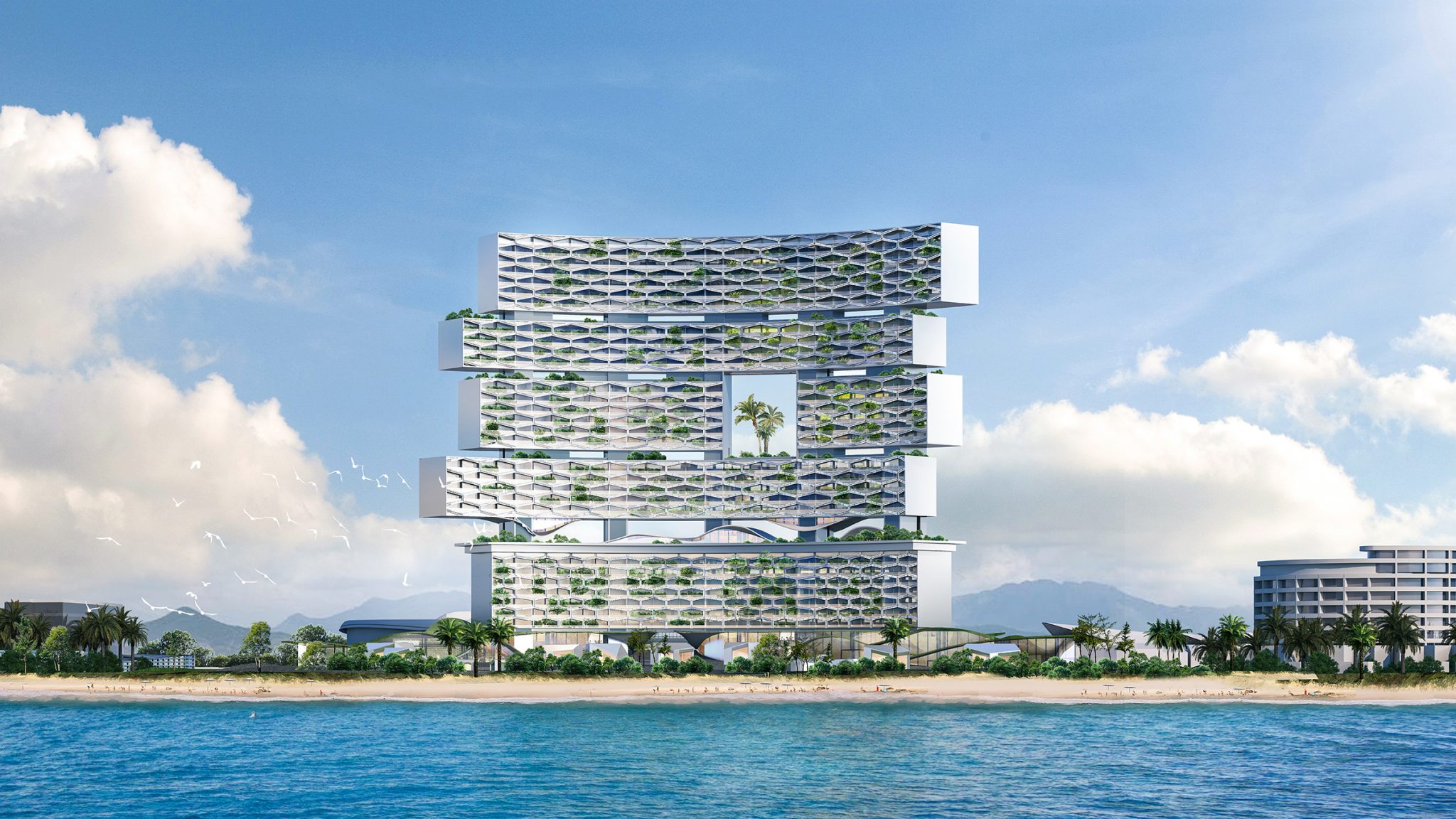
Sanya Horizons, a resort in Hainan Island, China, by architect Büro Ole Scheeren, aims to feature two hotels under IHG brands – The Regent Sanya Bay and Hotel Indigo Sanya Bay. Source: © Büro Ole Scheeren.
Notable projects:
Key People:
Tara Bernerd, founder
Tara Bernerd & Partners brings approachable luxury with an industrial edge to some of the poshest brands in hospitality, such as Belmond, Conrad, Thompson, and Rosewood. The firm strives to create connections for guests by evoking a distinct sense of place. The firm designed the interiors of Four Seasons Fort Lauderdale in a way that captures nostalgia for Florida’s yachting heritage. The resort palette includes a lot of cream, white, and taupe, along with polished walnut and rattan textures. Bernerd & Partners also did a full interior architecture and design for The Hari Hong Kong. Sumptuous leathers, dark woods, jewel tones, and low ambient lighting aim to mirror the opulence and vibrancy of the Hong Kong skyline at night. The design is assertive rather than quietly floral. Playfulness is another of Bernerd’s traits. The studio has made some guest room bathrooms more flexible by installing sliding walls.
-

Lobby bar at Thompson Hollywood by Tara Bernerd & Partners. Photo: Trevor Tondro. Source: Tara Bernerd & Partners. -

The lobby of the Four Seasons Fort Lauderdale. Design by Tara Bernerd & Partners. Photo by Rich Stapleton. Source: Tara Bernerd & Partners. -

Entrance lobby of The Hari Hong Kong by Tara Bernerd and Partners. Photo: Dennis Lo. Source: Tara Bernerd & Partners.
Stickman Tribe
A boutique design collaborative and interior design studio
Location: Dubai, UAE; Shanghai, China; Perth, Australia
Notable projects:
Key People:
Marcos Cain, founder and principal
High-end hotels in Gulf states often have a generic luxury look. But Dubai-headquartered Stickman Tribe broke with the trend when it designed the Fairmont Fujairah in the UAE. The resort is an art gallery with decor infused with subtle Arabic elements. A swimming pool features an eye-catching motif inspired by Persian carpets. An interior corridor has a wooden curtain made of oversized prayer beads. A hotel restaurant uses rope — tied in the manner of local pearl divers — to create a screening effect. Cultural fusion along these lines comes easy for Stickman Tribe, whose team comes from a dozen nations. For the firm, it was natural to design the gym walls of Jen Beijing by Shangri-La with a mix of inspirational graffiti and Bansky-style photo-realistic murals. It was all in keeping with Stickman Tribe’s mission to “pursue the unusual, the different, and the unimaginable to craft profitable, experience-led hospitality design.”
-

This public space at the Westin Dubai Mina Seyahi Beach Resort & Marina was designed by Stickman Tribe. Source: Stickman Tribe. -

The Terra restaurant at the Waldorf Astoria Maldives was designed by Stickman Tribe. Source: Stickman Tribe. -

An interior concept designed by design firm Stickman Tribe for the Fairmont Fujairah. Source: Stickman Tribe.
Notable projects:
Key People:
Bill Rooney, founder
Updating a classic property poses a special challenge for a hotel designer. Take the Cadillac Hotel in Miami, which had been designed seven decades ago. How could you retain its Art Deco glory while bringing its features into the new century? Call Bill Rooney Studio, that’s what you do. The firm creates spaces that are often highly stylized yet welcoming. For the Cadillac’s $47 million renovation, the firm preserved the original terrazzo floors in the lobby but added white stone flooring in many corridors. In the typical guest room, it placed 1940s photos while leaving exposed the white-washed beams in the ceilings. Meanwhile, at the Four Seasons One Dalton Street in Boston, the studio kept close to classic New England touches with the use of polished mahogany, soothing tones, fluting, Wilton-style carpet with windowpane patterning, grass cloth accents, retractable partitioning, light gray stone surfaces, embroidery, and herringbone wall coverings.


Notable projects:
Key People:
Yossapon Boonsom, director; Prapan Napawongdee, director; Namchai Saensupha, director
“Shma” means “the Earth,” and the Shma design firm specializes in landscape designs that enhance environmental sustainability and rethink social spaces. The firm, founded in 2007, works for many clients, including hotels. When The Standard recently opened its first property in Thailand, it tapped Shma’s landscape design for the project. Shma’s main approach was to preserve up to 234 existing trees, partly by placing small buildings around the trees and partly by moving them to new locations where they’re nursed to take root. The hotel’s spa, for instance, has a garden design with an existing rain tree preserved in the center of a public court and with wellness and “cannabliss” rooms spoking off the hub. “The project also values a lot on sharing appreciation for the design, lifestyle, food, music, and art,” the firm said. So Shma engineered the hotel’s layout to create buffers that separate zones, creating a sense of discovery as one goes from the main entrance to the spa and down towards the beach at the other end. The landscape design aims to spark emotional connections among guests.


[ad_2]
Source link


![[VIDÉO] Exportation : une hausse globale de 21 % pour les entreprises mauriciennes](https://i0.wp.com/zzz.mopays.com/wp-content/uploads/2022/08/vlcsnap-2022-08-17-09h43m32s817.png?fit=696%2C392&ssl=1 "[VIDÉO] Exportation : une hausse globale de 21 % pour les entreprises mauriciennes")


